

Baltimore City Public Schools alumni carry a universe-sized impact. Decades before contemporary engineers took the reins to operate cutting-edge observatories, City Schools trailblazers were pioneering technologies and shaping NASA's most critical missions.
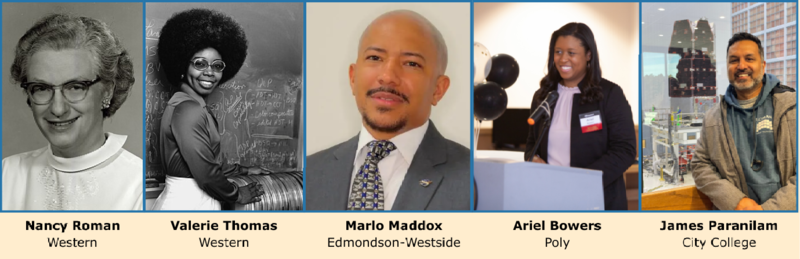 Nancy Grace Roman, a graduate of Western High School (Western), earned the title "Mother of Hubble" as NASA’s first Chief Astronomer. Her passion laid the groundwork for space observatories, turning Hubble into reality and earning her a namesake in NASA's flagship Nancy Grace Roman Space Telescope, which was recently launched.
Valerie Thomas, another Western graduate, made history as a NASA scientist, mathematician, and inventor. Over a multi-decade career, she managed image processing for the Landsat program and patented the 3D Illusion Transmitter in 1980—a technology adopted by NASA for optical visualization.
That legacy continues through alumni like Edmondson-Westside High School graduate Marlo Maddox. After starting as a NASA intern, he spent over two decades at Goddard Space Flight Center spearheading software development and leading heliophysics operations before rising to Deputy Director of the Flight Projects Directorate.
Connecting City Schools to the cosmos is seamless thanks in part to the Space Telescope Science Institute's (STScI) home in Baltimore. Ariel Bowers, Principal Systems Engineer and Operations Manager for the Roman Space Telescope Science Operations Center, and James Paranilam, Senior Test Engineer, are both City Schools alumni and spoke about how their education prepared them to help operate world-class space missions.
For both, their careers started in the classroom. Bowers credits her start to the Ingenuity Project at Baltimore Polytechnic Institute (Poly), landing a research practicum at STScI as a sophomore. As she recalls, "The work I completed over those two and a half years helped me win competitions through high school, enhance my college experience, and set me up for the career I have now". Paranilam points to a junior-year physics class at Baltimore City College (City College) with Mr. Miller, his AP History teacher and Mock Trial coach, noting that "working through problems in groups and applying the scientific method taught me the value of teamwork in understanding complex ideas."
Beyond classroom skills, both emphasize mindset and adaptability. For students intimidated by advanced STEM subjects, Paranilam offers perspective: "One thing many people don't realize is that it takes a wide range of talents to support space exploration... Math and science are incredibly important, but a successful organization depends on a diverse collection of skills and perspectives. If you're passionate about space, there are many different pathways to contributing to the mission."
Bringing the story full circle, Bowers now manages operations for the Roman telescope, a City Schools alum working on a project named after a fellow City Schools alumna. "I oversee operations at the Science Operations Center (SOC), and lead the SOC response to observatory and ground system anomalies," Bowers explained. "I have had the opportunity to work on the Hubble Space Telescope, the James Webb Space Telescope, and now the Nancy Grace Roman Space Telescope. To have contributed to three of NASA’s flagship astrophysics missions is something I’m incredibly proud of..."
Ultimately, both want local students to bust the myth that space exploration is reserved for the elite or only for those who love “rocket science.” Having walked the same high school halls as today's Baltimore youth, Paranilam encourages students to embrace their roots: "I was born and raised in Baltimore City... I'm a local kid who now helps support missions that explore the universe. Looking back, the path wasn't some impossible leap... For students in Baltimore today, my message is simple: don't underestimate where you come from. Your journey can take you farther than you imagine. The stars are the limit."
“Rocket science seems to be the general term used for anything related to space,” Bowers said. “And though that role is important and does exist, there are many other roles that serve important purposes as well. There are software engineers, systems engineers (me), operations, astronomers, instrument scientists, analysts, and project managers, just to name a few.”
Bowers encourages current students to stay curious: "Try and explore as many different facets of science and math as you can in an applied setting. STEM is so multidisciplinary; sometimes you discover interests or career paths you didn’t even know existed. For me, I knew I liked astronomy, but through internships and other hands-on experiences, I learned how much computers, coding, and technology are a part of astronomy as a whole... I realized I was interested in the engineering side, and that helped shape the direction I took with my college coursework, and ultimately my career."
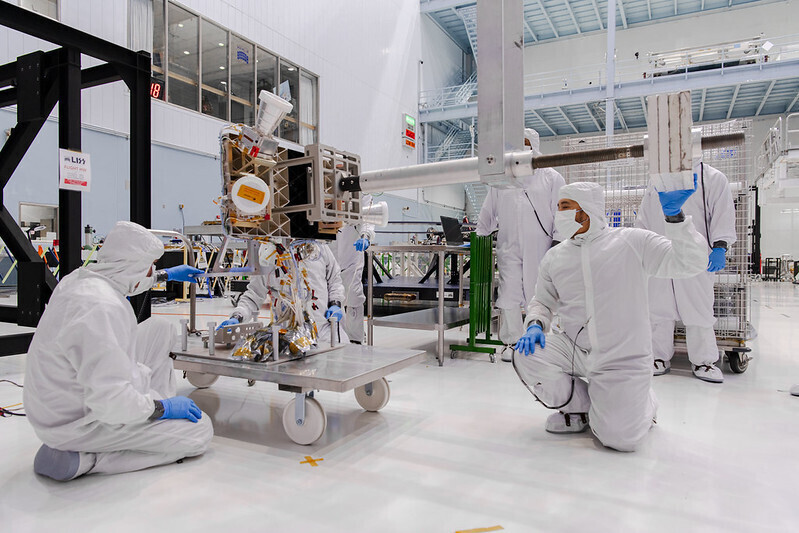 Photo: NASA Technicians hoist the Star Tracker Inertial Reference Unit (ST-IRU) from dolly, with a Module Installation Tool (MIT). Credit: NASA
These career successes reflect how City Schools students are career ready, world ready, future ready. Have a career that you want to share with our City Schools students and community? Contact us.
Header Image credit: NASA