

Spring is a season for celebrating the achievements of City Schools students—on the athletic field, in tournaments and national competitions, at graduation ceremonies, and in the classroom. Throughout April and May, students across Baltimore participated in the Maryland Comprehensive Assessment Program (MCAP), the state's annual assessment of student learning.
While this year’s results are still being processed, City Schools students have demonstrated steady academic progress over the past three years. During that time, the district has recorded gains in grade-level proficiency in both English Language Arts (ELA) and mathematics, with MCAP scores improving year after year and, in many cases, outpacing statewide growth in both subjects.
In the 2024-2025 school year, for example, 63% of students who took Algebra I at Thomas Johnson Elementary/Middle School scored a 3 or 4 on the MCAP Algebra 1 test, up from 58.3% the previous year and a 22.2 percentage point increase from the 2022-2023 school year (40.7%). According to the Maryland State Department of Education, students performing at levels 3 and 4 have demonstrated proficiency in the assessed content, readiness for the next grade level/course, and are likely on track for college and careers. The MCAP math scores at Matthew A. Henson Elementary School have increased more than 20 percentage points over the past three years, from <=5% in 2022 to 31.4% in 2025 for grades 3-5.
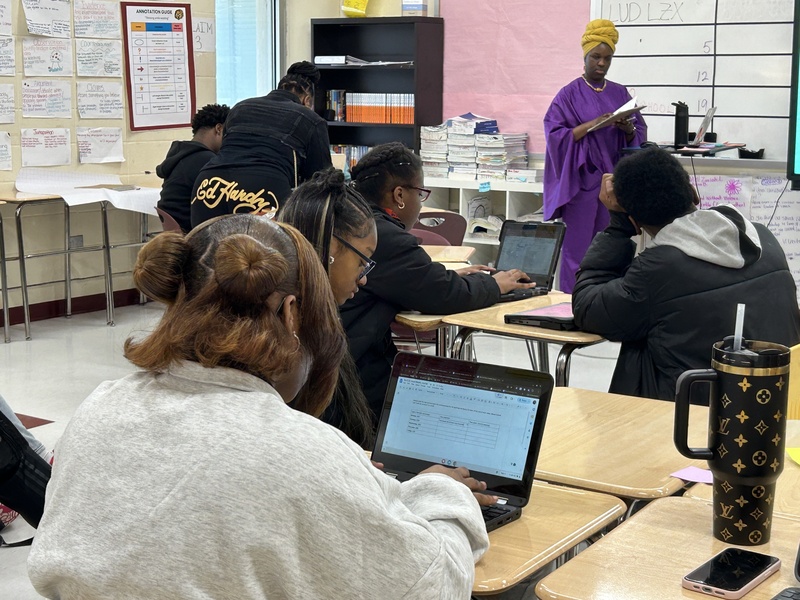
Of particular note is Dunbar’s success. MCAP ELA scores at Paul Laurence Dunbar High School (Dunbar) have also continued to increase over the past three years. Last year, the school recorded the largest gains of all schools throughout the state on the 10th grade ELA test, a 29.8 percentage point jump over the past three years from 33.6% in 2022 to 63.4% in 2024-2025.
City School students benefit from the many ways that their teachers and school leaders prepare them for MCAP assessments. Green Street Academy students and their families participated in MCAP Madness stations with reading comprehension challenges, math drills, chart analysis for science, and MCAP information for families, as well as fun games and creative motivation stations where scholars made signs to uplift and encourage their peers. Baltimore International Academy East and Park Heights Academy also hosted MCAP Family Engagement Nights for parents to learn about the tests and encourage their students. Many schools, including Morrell Park Elementary/Middle School, Furley Elementary School, and The Tunbridge School, held MCAP pep rallies with fun games and enthusiastic cheers (like Morrell Park’s "do your best on the test" to energize and motivate students).
At Bay-Brook Elementary/Middle School, students competed in MCAP Escape Rooms to enhance their skills with test-taking strategies; scholars worked in groups to complete each mission. Students at Woodhome Elementary/Middle School prepared for the test with creative “Cruising Into MCAP” experiences where they reviewed important skills, answered practice questions, and won prizes for correct answers. The engaging events reinforced skills and helped build confidence, motivation, and excitement for MCAP testing.
Last year’s ELA test takers at Dunbar who achieved the single-highest increase in a year in Maryland are now in 11th grade and attribute their success to these preparation strategies. They credit their teachers with their class’s overall success.
“Our teachers helped us take the test seriously,” said Isiah. “And they got us in the mindset of testing by going over testing etiquette,” echoed Reon. Their classmate Malik pointed to vocabulary reviews as an important part of their test preparation, and “we were constantly writing essays,” added Braylen.
“We developed a stamina for test taking,” noted current 11th grader Kevin. “We knew we needed to understand and integrate the strategies our teachers introduced us to.”
The tenth grade English teachers at Dunbar are equally pleased with the MCAP scores:
“We’re setting the bar, and students have to meet us there,” said Alice “Ms. Queen” Olom. “They’re learning how to be college students.”
“When we set a high expectation, students rise to that occasion,” said Saffroun Barrow. “We’re intentional. When we reinforce concepts and practices, they stick.”
That reinforcement comes from constant collaboration among the school’s English teachers. Teacher Jordan-Brittany Cook-Wise notes that “we share ideas and lesson plans, and meet weekly to discuss student growth and needs.”
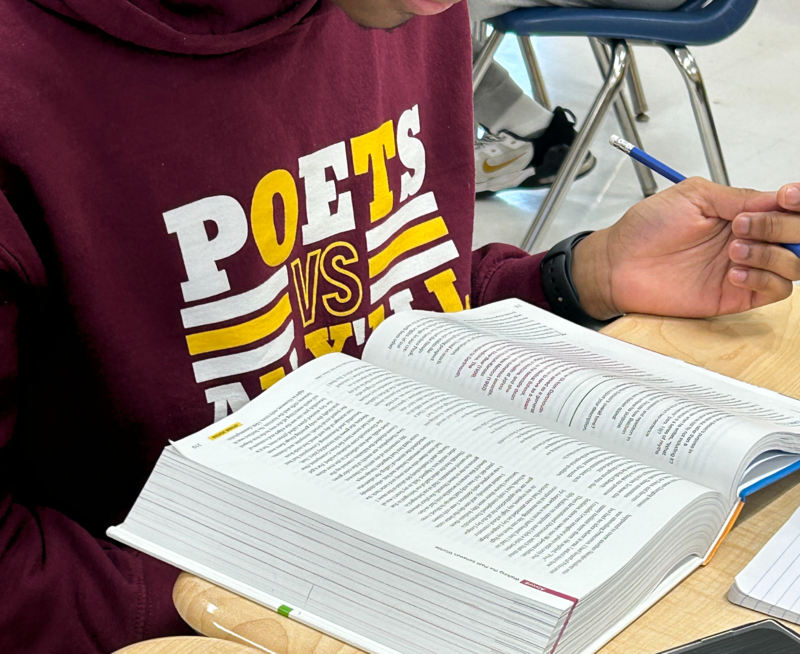
Students participate in writing boot camps and workshops where each of the five English teachers coordinate a focus on a different aspect of writing. On Flex Fridays, students move among teacher-led stations as they explore specific content, such as sentence structure and persuasion, with each other.
Says teacher Taylor Stevenson. “We hear and respect each other’s voices, which makes it easy for us to lean on each other and share.”
Adds teacher Steven Wolf, “We’re a serious academic school, so we find ways to work foundational skills into the rigorous college-level curriculum.”
The Springboard 10th grade curriculum at Dunbar focuses on informational and argumentative writing. On a recent morning, students participated in a Socratic seminar debate—and prepared for the upcoming MCAP test. After introducing the assignment, students were asked to write a paragraph in eight minutes about herd immunity. The students then analyzed each other’s work to determine if their paragraphs used the RACES strategy (Restate the question, Answer the question, Cite evidence, Explain the evidence, and Summarize the points) or the MEAL strategy (stating a Main idea, providing Evidence or Examples, doing an Analysis that interprets the significance of the evidence, and Linking back to the main idea).
“These teachers teach with their whole heart,” said Dunbar Educational Associate Meredith Maddox. “The energy from their collaborative planning and teaching means that students get the experience and brainwork of the entire team.”
Their students' success is a testament to that commitment.