
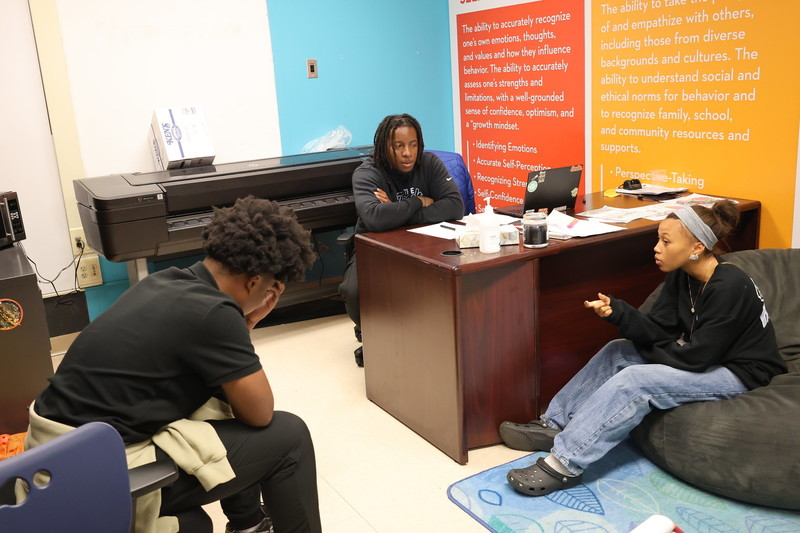
Travis Jenkins, a hall monitor at Beechfield Elementary/Middle School, sat facing 8th graders Trevor* and Cassidy*.
“If there’s a problem, you need to say something,” he said to Trevor. “Speak your mind. Tell her how you feel. Look up and say it to her.”
“Cassidy, you have the resources. You need to use them,” Mr. Jenkins coached Cassidy. “Listen to understand, not respond.”
Trevor and Cassidy are friends, often joking around with each other. But when a lighthearted exchange suddenly evolved into name-calling, their teacher invited the students to participate in a restorative circle session with Mr. Jenkins.
After their 20-minute conversation, Cassidy acknowledged that it didn’t matter who started the argument. “I know that now,” she realized. “I need to watch what I say so we don’t agitate each other.”
“And I know I didn’t need to give it back to her,” said Trevor.
Beechfield is one of over 100 city schools whose staff have been trained in incorporating Restorative Practices, the evidence-based strategy of building open, respectful communication that reduces conflict and repair harm in lieu of punishment. The Office of Schools continues to expand the number of schools trained in restorative practices, directly fostering a stronger sense of community in schools by teaching and supporting interpersonal skills.
“It’s a preventative strategy,” says Erik Bandzak, City Schools Director of School Culture and Climate. “Schools that actively incorporate Restorative Practices see a reduction in suspensions and chronic absences. Kids want to come to school. They feel supported and have a voice.”
A report issued by Open Society Institute-Baltimore, Baltimore City Public Schools, Johns Hopkins University Institute for Education, and the University of Maryland Francis King Carey School of Law.
gives a clear indication that implementation of restorative practices in City Schools is having a definitive, positive impact for students, teachers, and administrators. The study found that, in schools where restorative practices had been implemented:
School suspensions dropped by 44% in one year
72% of school staff reported improved school climate
69% of school staff reported improved student respect for one another
64% of school staff reported improved student respect for staff
Restorative Practices are an integral part of a school’s Climate Plan, which outlines the methodology behind fostering respectful and safe relationships in the greater school community. This plan of action builds a culture that supports academic success and nurtures social-emotional growth. The strategy directly supports City Schools Portrait of a Graduate: as Creative and Innovative Thinkers, students learn problem-solving. As Responsible Citizens, they learn to act with empathy and integrity. As Effective Communicators, they practice the productive exchange of ideas. Ultimately, students can Confidently reflect on successes and failures as they reach workable solutions.
Teachers and staff are trained by both district and school leaders in how to implement practices like restorative circles, where students share their feelings, address conflicts, and offer praise in a safe and nurturing conversation—like the one between Trevor and Cassidy. Other practices being piloted in schools include peer mediation and leadership development.
“We see a change when we build the capacity of staff,” says Beechfield Assistant Principal Kelly Wilhelm. “We see our kids as people and help them see each other. We’re helping them understand that everything we do has an impact, often with consequences. Students are learning how to acknowledge them.”
In a restorative circle at Hampstead Hill Academy, for example, one student apologized to his teacher for “talking in her class while I was still trying to focus and not listening when I was trying my best.”
“Restorative practices definitely impact the climate and culture of the school. It helps everyone see and hear each other, and that makes it much easier to focus on teaching and learning,” comments Hampstead Hill principal Matt Hornbeck.
“Students need to understand they have a voice,” says Beechfield’s Mr. Jenkins.
“Circles make me more empathetic and understanding,” reports a Hampstead Hill student.
“A couple years ago, I was a conflict kid," admits a City Spring student. “I used to be in a lot of drama and I used to pick on girls. (I thought) how would I feel if I was the one getting bullied or picked on by the same person every day? So I had to put myself inside the girl’s shoes I was arguing with.”
At City Springs Elementary/Middle School, Restorative Practices also build a sense of community while fostering learning. Like at most schools, all students participate in a daily classroom circle or can request a one-on-one or small group circle to address a specific issue with other students.
“Some teachers teach in a circle,” says City Springs principal Rhonda Richetta. “The restorative approach to academics helps students get along with each other. There are fewer conflicts, and conflicts that come up are resolved in a positive, empathetic way.”
Adds City Springs’ Director of Restorative Practices Todd Wade. “We’re showing kids how to resolve problems in a different way. They’re building their muscle of accountability, responsibility, and acceptance. It’s setting them up for success later in life.”
At City Springs, suspensions were reduced by 78% the year that the practice was implemented; this year, there have been 10. There were more than twice that amount last year at this time. Chronic absenteeism has been reduced from 69% to 43%. The suspension rate at Beechfield has dropped over 80% since Restorative Practices began at the school.
Parents also recognize the impact of Restorative Practices. In a recent climate survey, 95% of City Springs parents said they were pleased with the school climate.
“If the culture is positive and conducive to learning, learning happens,” says Principal Richetta.
For more information about Restorative Practices, check out additional information on the City Schools website.
*Student names have been changed for privacy.